22 July 2026
BBA vs MBA for Entrepreneurship: Does the Right BBA Make the Difference?
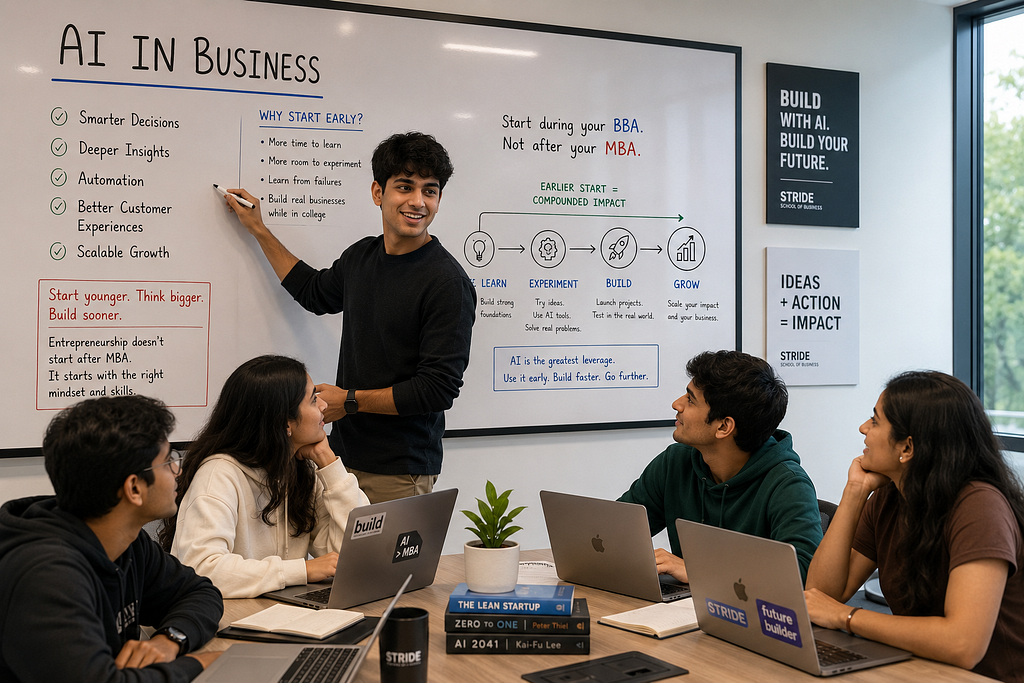
For students interested in entrepreneurship, an MBA often feels like the next step after graduation. It’s seen as the qualification that teaches how to build a business and become a successful entrepreneur. As a result, many aspiring founders wonder whether they need an MBA before they can start a business of their own.
However, today’s founders have access to AI tools and resources that make it possible to validate ideas, understand customers, and even launch businesses much earlier than before.
According to the GEM 2025/2026 Global Report, startup activity has reached record highs across many economies, highlighting that more people are choosing entrepreneurship than ever before. As opportunities to build businesses continue to grow, aspiring entrepreneurs need practical business skills and experience from an early stage.
So, if entrepreneurship is your goal, what prepares you better: waiting for an MBA, or choosing a BBA that starts building entrepreneurial skills from day one?
Does an MBA Actually Teach Entrepreneurship?
An MBA is designed to help students understand how businesses operate and are managed. It covers the core business domains such as marketing, finance, operations, and human resources.
However, entrepreneurship is about more than understanding business concepts. Building a business involves identifying opportunities, validating ideas, understanding customers, managing finances, solving real problems, and adapting quickly when things don’t go according to plan. These skills develop most commonly through practical experiences.
This doesn’t mean an MBA has no role in entrepreneurship. It can certainly help entrepreneurs work on their business knowledge and expand their professional network. But entrepreneurship itself is not something that begins with a postgraduate degree. Many of the skills needed to start and grow a business can be developed much earlier through practical learning and hands-on experience during undergraduate education.
Why the Right BBA Gives Entrepreneurs a Head Start
Many students believe entrepreneurship begins after an MBA or several years of work experience. While that path works for some, it is not the only way to build a successful business. Today’s entrepreneurs have access to AI tools, digital platforms, and resources that make it possible to start much earlier.
A BBA with AI gives students something that cannot be compressed into a one- or two-year postgraduate program: time. Over three years, students can experiment with ideas, make mistakes, improve their thinking, and gradually build confidence. Rather than learning entrepreneurship only through theory, they gain practical exposure while discovering what kind of entrepreneur they want to become.
A BBA with AI also gives students the opportunity to test ideas before the stakes become much higher. Instead of waiting for graduation to take their first step, students can spend their college years understanding customers, validating business ideas, learning from failures, and refining their approach. This gradual learning process helps aspiring entrepreneurs in being better prepared to launch and grow businesses in the future.
Stride School of Business Helps Students Build Businesses, Not Just Study Them
At Stride School of Business, students won’t wait until after graduation to start thinking like entrepreneurs. Instead, the three years develop the knowledge, practical skills, and experience required to build and grow a business.
Students analyse listed companies, break down financial statements, study market size and unit economics, and learn how businesses create value. Alongside these fundamentals, they use AI to conduct business research, prepare reports, and create marketing content.
As students progress through the program, they move from analysis and to applying what they have learned. They study customer segmentation, competitor analysis, pricing strategy, financial modelling, business negotiation, and digital marketing while building analytics dashboards and AI-powered business systems. Students solve real business challenges that simulate the decisions entrepreneurs make every day.
The learning experience reaches its peak as students launch a real business using AI-powered tools, build marketing campaigns, acquire customers, generate revenue, and manage day-to-day operations. Before graduating, students experience what it takes to validate an idea, adapt to market feedback, and operate a business in the real world.
Throughout the three years, students also complete industry internships, build a portfolio of 25+ practical business projects, earn industry-recognised certifications, and learn to use AI. For promising ventures, Stride School of Business also provides seed funding of up to ₹1 crore, giving students the opportunity to transform strong ideas into scalable businesses.
Final Perspectives
An MBA can be a valuable step for many aspiring entrepreneurs, but it is not where entrepreneurship begins. The ability to build a business is developed through continuous learning and practical experience, skills that can be developed .
At Stride School of Business, we believe students shouldn’t have to wait until after graduation to start thinking like entrepreneurs. By combining strong business fundamentals with AI, real business projects, industry mentorship, and opportunities to launch ventures, students graduate with more than a degree, the entrepreneurial mindset to build the future they envision.
FAQs
1) Do I need an MBA to start a business?
No. An MBA is not a requirement for becoming an entrepreneur. Many successful founders started their businesses without an MBA through practical experiences and continuous learning.
2) Can I start a business after completing a BBA?
Yes. A BBA provides a strong foundation in business. When combined with practical experience, it can prepare students to start and grow their own ventures.
3) What skills are more important than an MBA for entrepreneurs?
Successful entrepreneurs need skills such as understanding customers, problem-solving, business strategy, communication, and decision-making. The ability to use AI is also a necessity.
4) Should I gain work experience before starting a business?
Work experience can be beneficial, but not always needed. Students can develop entrepreneurial skills during college by working on live projects, completing internships, and testing business ideas in a structured learning environment.
5. How does Stride School of Business prepare students for entrepreneurship?
At Stride School of Business, students develop entrepreneurial skills through live projects, AI-powered learning, industry mentorship, and internships. Students also launch a real business. Students build a portfolio of 25+ projects, earn industry-recognised certifications, and promising ventures can receive seed funding of up to ₹1 crore.