18 July 2026
Can AI Replace Business Graduates?
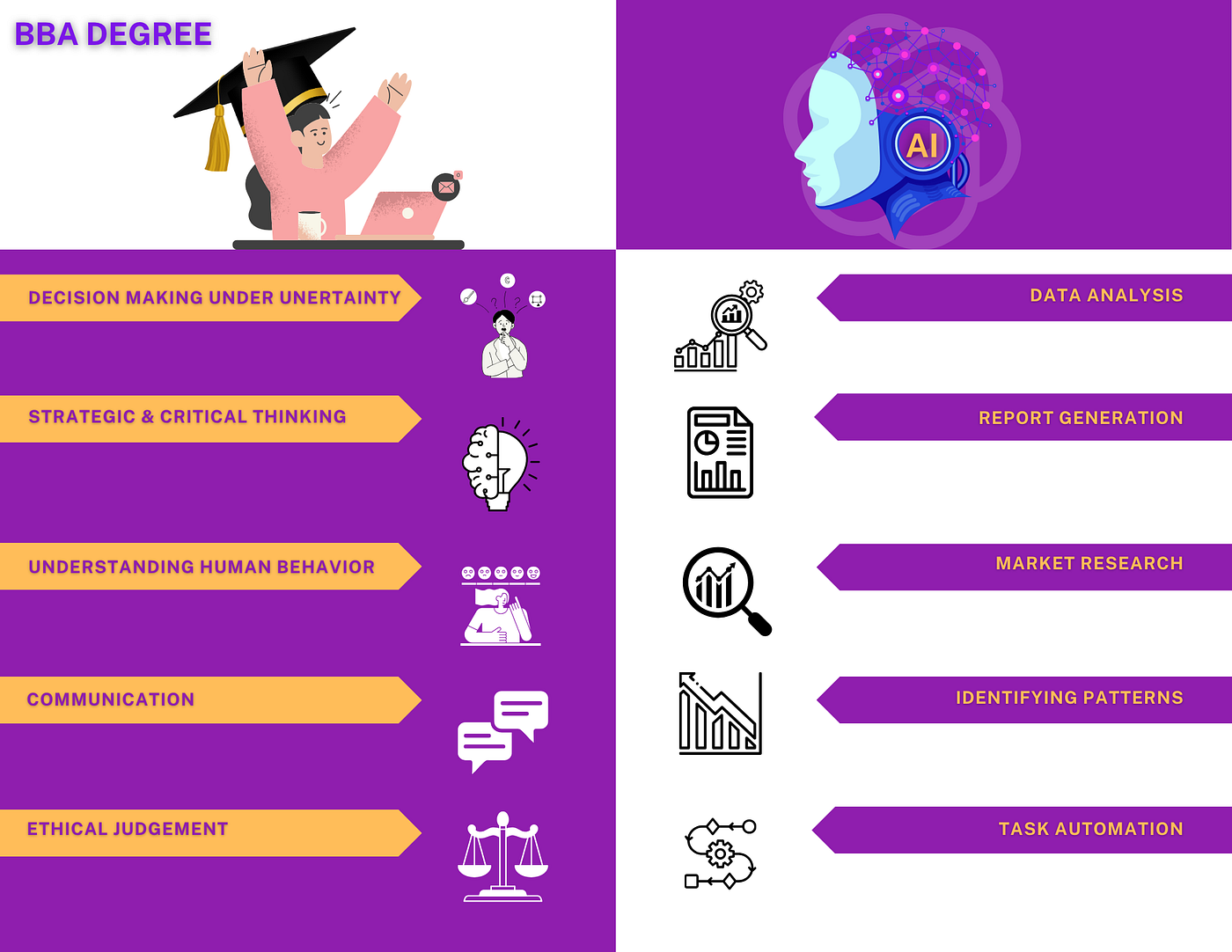
AI has quickly transformed from being an assistive tool to becoming a core part of decision-making across industries. As AI systems become more capable of analysing data, generating insights, and making recommendations, a question is being asked now more than ever:
Can AI replace business graduates?
This question is especially relevant for students pursuing or planning to pursue degrees in marketing, finance, human resources, operations, and entrepreneurship.
At first, it may seem like AI is becoming capable of performing tasks traditionally done by business professionals. Reports, data analysis, customer segmentation, and strategic suggestions can be generated within seconds using AI.
However, this raises a deeper question, not whether AI can perform tasks, but whether it can replace the human judgment required in real business situations.
According to the World Economic Forum Future of Jobs Report 2025, 39% of workers’ core skills are expected to change by 2030, mostly due to automation and AI integration. At the same time, the IMF estimates that nearly 40% of global employment is exposed to AI.
This means AI is not simply entering the workforce, but it is reshaping it. But replacing business graduates entirely is a very different question.
For students exploring BBA after 12th, this raises an important concern: if AI is changing business careers so rapidly, what kind of business education will actually prepare them for the future?
What AI Can Replace — And What It Cannot
Much of the fear surrounding AI comes from the belief that it can replace entire jobs. But what many don’t realize is that AI is far better at replacing tasks than it is at replacing professionals.
Across business functions, AI is already automating repetitive work such as report generation, basic market research, data entry, and information summarisation.
However, business careers require much more than just execution. AI can process information and provide recommendations, but it cannot build relationships, negotiate complex agreements, understand organisational culture, or make decisions in uncertain situations. Human judgment is still essential.
This is reflected in employer expectations as well. According to the World Economic Forum’s Future of Jobs Report 2025, the following remain among the most valued skills in the workforce:
- Analytical thinking
- Leadership
- Resilience
- Creative thinking
As AI becomes better at execution, unique human capabilities become even more important. AI is not replacing business graduates, it is changing the nature of their work and increasing the value of skills that machines cannot replicate.
Why The Right Business Graduates Will Become More Valuable
On the contrary to widely common belief, AI may actually increase the value of business graduates rather than eliminate them.
As AI handles more routine and repetitive work, professionals are able to spend less time on execution and more time on activities that drive business growth. Instead of manually gathering information, they can focus on interpretation, evaluation, and making strategic decisions.
This is important because AI does not operate independently. It still requires humans to define objectives, provide context, assess outputs, and determine the best course of action. A finance professional must decide whether an AI-generated forecast is realistic. A marketer must determine whether an AI-generated campaign aligns with the brand.
This is one reason why employers continue to prioritise skills such as analytical thinking, communication, leadership, and problem-solving. As AI becomes more capable, the ability to combine business knowledge with sound judgment becomes increasingly valuable.
For business graduates, the opportunity is not to compete with AI, but to learn how to use it effectively.
The business graduates who thrive in the coming decade are unlikely to be those who simply possess theoretical knowledge. They will be the ones who can apply business concepts using modern tools, analyse information effectively, and adapt to changing technologies.
This is creating a growing difference between traditional graduates and future-ready graduates.
What Should Students Look For In A BBA Today?
AI is changing the nature of business careers, students should decide on business programs differently than they did a few years ago.
For decades, choosing a BBA program was about factors such as college reputation, location, fees, and placements. While these factors are important, they no longer provide the complete picture.
Today’s students are entering a business environment where employers value practical and technological skills to solve real-world problems. Hence students should look beyond the degree and evaluate how effectively a program prepares them for modern businesses.
Important questions to ask are:
- If the program provides practical business projects?
- Are students exposed to AI tools being used across industries?
- Does the curriculum encourage problem-solving and critical thinking?
- Are internships and real-world experiences integrated into the learning journey?
- Will students graduate with demonstrable skills in addition to academic knowledge?
These questions are important because employers are no longer hiring based only on qualifications. They are looking for graduates who can contribute, adapt, and create value from the beginning of their careers.
For students exploring BBA after 12th, the goal should not only be earning a degree. The goal should be choosing a program that prepares them for the future of business, where business knowledge and technology increasingly work hand in hand.
The shift is one of the reasons why new-age business education models are emerging. For example, Stride School of Business, India’s first AI-native business school, combines traditional business fundamentals with AI tools, practical projects, AI industry certifications, and real-world business exposure. The objective is not simply to help students earn a BBA degree, but to ensure they graduate with the skills, experiences, and technological fluency that modern employers value now more than ever.
FAQs
Q1) Can AI completely replace business graduates?
No. While AI can automate repetitive tasks, it cannot fully replace human skills. Business graduates continue to play a critical role in interpreting information and making business decisions.
Q2) Which business jobs are most affected by AI?
AI is having a significant impact across marketing, finance, HR, operations, and analytics. However, it is primarily changing how these jobs are performed rather than eliminating them entirely. Professionals are increasingly expected to work alongside AI tools to improve productivity and decision-making.
Q3) What skills will business graduates need in the future?
Future business professionals will need a combination of business fundamentals and AI literacy. Skills such as critical thinking, problem-solving, communication, leadership, data interpretation, and the ability to effectively use AI tools are becoming extremely valuable.
Q4) Is a traditional BBA enough in the age of AI?
A traditional BBA still provides an important foundation in business concepts. However, many employers now expect graduates to have practical experience, exposure to modern technologies, and the ability to apply business knowledge using AI-powered tools and workflows.
Q5) How can students prepare for AI-driven business careers?
Students should focus on developing strong business fundamentals while also gaining hands-on experience with AI tools, projects, internships, case studies, and real-world problem-solving. The ability to adapt and continuously learn will be crucial in a rapidly changing workplace.
Q6) What makes AI-integrated business education different?
AI-integrated business education combines traditional business subjects with practical exposure to AI tools, industry projects, certifications, and modern business workflows. The goal is to help students understand not only business theory but also how businesses operate in an increasingly AI-driven world.