18 July 2026
How AI Is Changing Business Careers Forever
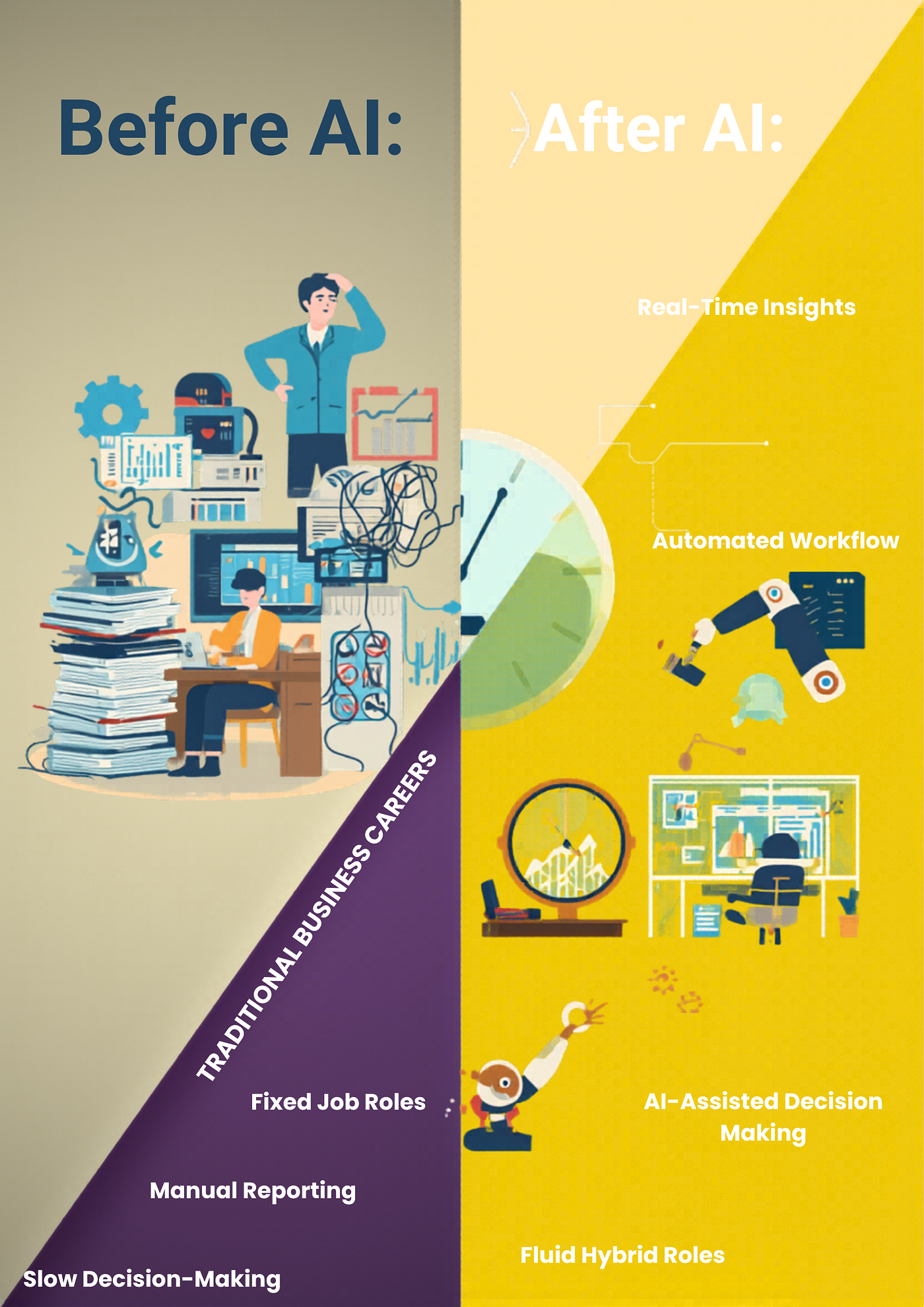
Business careers are going through one of the most impactful transformations in modern history.
What used to be clearly defined roles like marketing, finance, human resources, and operations are no longer limited to fixed responsibilities. Instead, they are rapidly changing into dynamic, AI-augmented roles where employees are expected to work with artificial intelligence to make quicker and more accurate decisions.
According to the World Economic Forum’s Future of Jobs Report 2025, nearly 39% of workers’ core skills are expected to change within the next five years, mostly because of the rise of AI. A significant portion of what is considered “important skills” today will not remain the same in the near future.
At the same time, AI adoption in workplaces has accelerated at an unprecedented pace. A 2025 McKinsey Global Survey on AI found that more than half of organizations globally have already adopted AI or have begun experimenting with AI agents in at least one business function.
This means one clear thing: AI is no longer changing business careers in isolation but it is reshaping every function simultaneously. As a result, business roles are shifting from task-based execution to decision-making, analysis, and strategy-driven functions supported by AI tools.
The professionals of the future will not be defined by how much work they do manually, but by how effectively they can use AI to think, analyze, and solve problems.
How AI is transforming business functions
The impact of AI on business careers is shown by how it is transforming individual business functions. Marketing, finance, human resources, and operations are no longer operating in traditional ways they are being redefined by AI.
Marketing:
Marketing has undergone one of the most visible transformations due to AI. Today, AI tools are used to:
- Generate advertisements and creative content
- Analyse customer behaviour and segmentation
- Optimise campaign performance in real time
Finance:
Finance roles are also being reshaped by automation and AI-driven analytics. Professionals now use AI systems to:
- Forecast financial trends
- Detect anomalies and fraud patterns
- Run scenario-based analysis
Human Resources:
AI is also changing how organisations hire and manage people. HR teams now use AI for:
- Resume screening and candidate shortlisting
- Predicting employee performance and retention
- Automating repetitive recruitment tasks
Operations:
Operations have become highly AI-driven, especially in large organisations. AI is now used to:
- Optimise supply chains
- Predict demand and inventory needs
- Improve efficiency in production systems
New AI-Supported job roles + Shift in skills
As AI continues to transform business functions, it is also reshaping the kinds of job roles that are emerging in the market. Traditional jobs are not disappearing entirely, but they are developing into hybrid versions that require AI skills.
Across several industries, there has already been a rise in new jobs like:
- AI Marketing Strategist
- Growth Analyst (AI-driven)
- Business Intelligence + AI Analyst
Such roles did not exist in traditional business education pathways, but they are quickly becoming highly relevant in the modern world.
What makes these roles different is not their titles, but the tasks and expectations that come with these roles, integration of AI is no longer optional but rather it is a necessity to stay relevant and compete with others. Earlier, professionals were valued for what they could execute. Today, they are valued for what they can interpret, design, and improve using AI.
This has created a clear shift:
- From task execution → to problem solving
- From manual analysis → to AI-assisted insights
- From fixed roles → to flexible hybrid careers
- From routine work → to strategic thinking
While AI is creating new opportunities, it is also reducing the need for repetitive tasks. These roles are now automated or heavily AI-assisted. This does not mean these roles disappear completely, but their value contribution within organisations is reducing significantly.
What should students do to stay relevant
As AI continues to reshape business careers, the most important question for students is what skills will remain relevant in the future. The traditional approach of focusing only on theoretical knowledge is no longer sufficient in an AI-driven business world. Students entering fields like marketing, finance, HR, operations, or entrepreneurship now need to develop a much broader set of capabilities that go beyond textbooks.
It is not enough to simply know how to use AI tools. Students need to understand:
- How AI systems generate outputs
- How to evaluate accuracy and reliability
- When to trust AI — and when not to
Employers are increasingly looking for individuals who can:
- Identify real business problems
- Break them into structured parts
- Use AI tools to find solutions
AI can provide answers, but humans are still responsible for defining the problem correctly.
Business fundamentals are still important but they are no longer enough on their own. Students must learn how to combine:
- Marketing + AI analytics
- Finance + forecasting and modeling
- HR + AI-driven hiring systems
- Operations + automation tools
One of the biggest shifts happening in education is that students are no longer expected to just know things. They are expected to:
- Apply knowledge
- Build projects
- Work with real tools
This shift is what separates job-ready graduates from degree-only graduates.
How education must evolve
As business careers evolve with AI, it is clear that traditional business education is no longer sufficient on its own. The gap between traditional education and industry expectations has led to the emergence of new-age learning models that focus on AI-integrated business education.
One such approach is being taken by Stride School of Business, India’s first AI-native business school, which focuses on combining core business fundamentals with AI tools, real-world projects, internships, and industry exposure.
Instead of limiting learning to textbooks, the focus is on helping students:
- Work with AI tools used in real companies
- Solve business problems through applied projects
- Build practical skills alongside theoretical knowledge
- Develop job-ready capabilities from day one
The idea is not to replace traditional business education entirely, but to evolve it in a way that aligns with how modern businesses actually function.
FAQs
Q1) How is AI changing business careers?
AI is transforming business careers by automating repetitive tasks and shifting roles toward decision-making, strategy, and analysis. Functions like marketing, finance, HR, and operations are now increasingly AI-augmented rather than purely manual.
Q2) What are the new career options in business after AI?
New AI-driven roles include AI marketing strategist, automation specialist, growth analyst, business intelligence analyst, and AI product manager. These roles combine business knowledge with AI tools and data-driven decision-making.
Q3) What skills are needed for future business careers?
Future business professionals need AI literacy, data interpretation skills, critical thinking, problem-solving ability, adaptability, and strong communication skills along with core business fundamentals.
Q4) How can students prepare for AI-driven business careers?
Students should focus on learning how to use AI tools effectively, understand business fundamentals deeply, work on real projects, and develop the ability to apply knowledge in practical scenarios.
Q5). Are AI skills more important than a degree?
AI skills are becoming increasingly important, but degrees still provide foundational knowledge. The strongest advantage comes from combining both academic learning and practical AI-based skills.
Q6) How is Stride School of Business different from traditional business education?
Stride School of Business focuses on integrating business education with AI tools, real-world projects, and industry exposure, helping students develop practical, job-ready skills aligned with modern business environments.