27 July 2026
How Businesses Actually Work and Why BBA Needs to Teach That
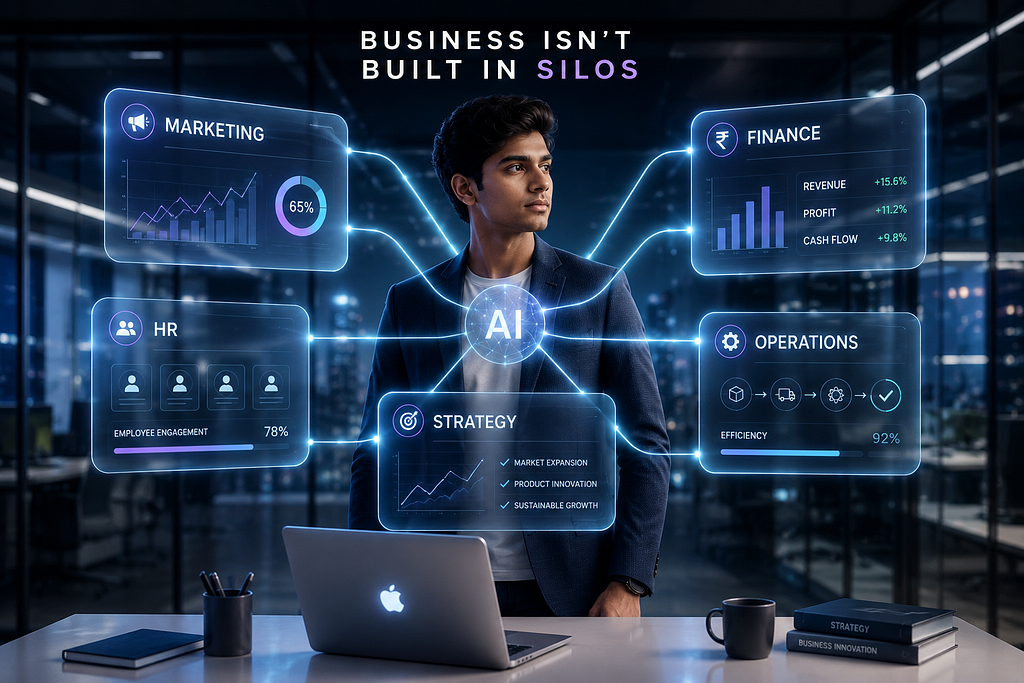
Every successful business depends on different functions working towards the same goal. Marketing understands customers, finance evaluates opportunities, human resources build capable teams, operations ensure efficient execution, and strategy brings everything together to drive long-term growth. While technology and AI continue to change the way these functions operate, businesses have always relied on collaboration rather than isolated decision-making.
However, BBA still teaches these subjects as separate disciplines, giving students limited opportunities to understand how they work together in real organisations. In today’s business environment, decisions are rarely made in isolation. Marketing, finance, human resources, operations, and strategy constantly influence one another, making it essential for BBA to prepare students for the way modern businesses actually operate.
So, how do businesses actually work, and why should colleges teach business in the same way?
Businesses Don’t Work Having Isolated Departments
In the real world, business functions don’t operate independently. A marketing campaign affects sales forecasts, finance determines budgets, operations manage delivery, and human resources ensure the right people are in place to execute plans. Every major business decision involves multiple teams working together towards a common objective.
BBA students need to understand how different departments connect, communicate, and influence one another. A modern BBA should therefore prepare students to think across functions, solve problems collaboratively, and apply business knowledge in the same way organisations operate today.
It All Starts with the Customer
No business begins by building a product and hoping someone buys it. Every successful business starts by understanding its customers. Before launching a new product or entering a new market, companies spend time identifying customer needs, studying competitors, estimating market size, and validating demand. These insights shape almost every business decision that follows.
BBA students should learn how to conduct market research, analyse customer segments, evaluate competitors, build marketing strategies, and use AI to generate insights that help businesses make better decisions long before a campaign goes live.
Every Business Idea Must Make Financial Sense
Understanding customers is only the beginning. Before launching a product or entering a new market, companies ask if it will be financially viable? Every major business decision depends on understanding costs, pricing, profitability, cash flow, and future growth.
This is why finance is about much more than calculations. BBA students should learn how to read financial statements and build models, analyse performance, and use AI to compare statements.
Great Businesses Are Built on Great Execution
A good business idea only succeeds when it can be delivered consistently. Once a product or service is launched, businesses need efficient systems to manage inventory, coordinate teams, monitor performance, and ensure customers receive the experience they expect. As organisations grow, these processes become even more important.
BBA students should learn how businesses optimise workflows, improve efficiency, analyse operational data, and use AI to automate repetitive processes and support better decision-making. These skills help businesses scale without compromising quality or customer experience.
Great Businesses Are Built by Great People
Behind every successful business is a team that turns ideas into reality. As businesses grow, they need people who can collaborate, lead, and adapt to change. Hiring the right talent, developing teams, and creating a strong workplace culture is just as important as attracting customers or managing finances.
BBA students should understand how businesses build high-performing teams, develop leadership and communication skills, manage workplace challenges, and make informed people decisions. As AI becomes part of recruitment and workforce planning, future business professionals should also learn how technology can streamline these processes.
Every Business Needs Someone Who Sees the Bigger Picture
Every business function plays an important role, but long-term success depends on bringing them together. Business leaders constantly balance customer needs, financial performance, operational efficiency, and people management before making strategic decisions. They don’t make decisions based on one department, they look at the business as a whole.
BBA students should learn how to identify growth opportunities, solve complex problems, and use AI to support data-driven decision-making. These skills help future professionals think beyond individual functions and understand how businesses grow and adapt in a changing market.
How Does Stride School of Business Bring It All Together?
Understanding how businesses work requires opportunities to apply practical and theoretical knowledge in real business situations. This is the approach followed at Stride School of Business, where students build practical skills progressively over three years instead of waiting until the end of their degree for industry exposure.
From the first semester, students analyse listed companies, break down financial statements, and create AI-powered marketing content. As they progress, they build content channels, create analytics dashboards, and conduct competitive analysis. They also launch real businesses and work on consulting projects, AI audits, and business strategy.
Throughout the program, students work with 15+ AI tools like Claude, Perplexity, Gamma, Gemini, Canva AI, and many more. Students also complete 25+ real business projects and earn 10+ AI industry-recognised certificates.
Final Perspectives
Businesses succeed when all the core functions work together to solve problems and create value. This is how organisations operate in the real world, and it is how business education should prepare students.
A modern BBA with AI should help students understand how every business function connects while giving them opportunities to apply that knowledge through real business projects, industry exposure, and practical experience. Students who develop this broad understanding will be better prepared for the future.
FAQs
1) Why is it important to understand multiple business functions during a BBA?
Because businesses don’t operate in isolation. Marketing, finance, HR, operations, and strategy work together to achieve business goals.
2) Do businesses expect graduates to specialise in one function?
Not initially. Employers value graduates who understand how different business functions connect and contribute to decision-making.
3) How is a modern BBA with AI different from a traditional BBA?
It combines business fundamentals with practical projects, AI tools, internships, and real-world business applications instead of focusing only on theory.
4) How does Stride School of Business prepare students for modern businesses?
Stride School of Business helps students apply business concepts through 25+ real projects, internships, AI tools, industry certifications, and practical learning across every major business function.