3 June 2026
Prompt Engineering vs Real AI Skills: What Students Should Learn
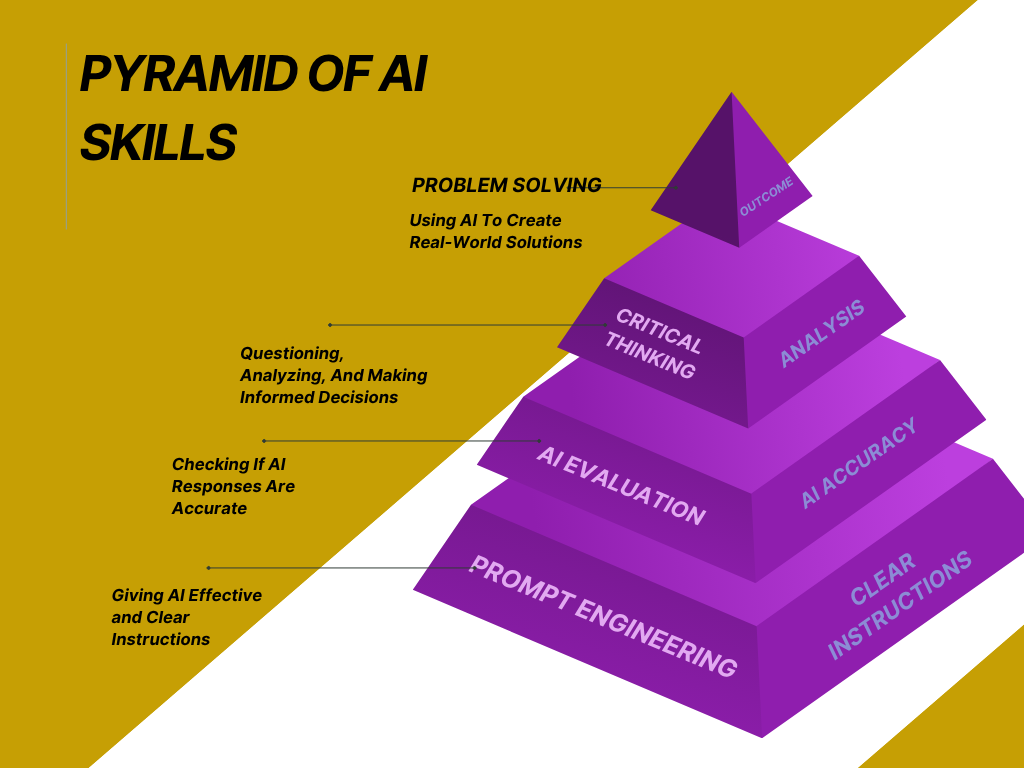
Over the past two years, not many skills have gained as much attention as prompt engineering has. From online courses and certifications to social media tutorials and YouTube advertisements, students are constantly being told that learning how to write better prompts is the key to having a successful career in the age of Artificial Intelligence.
Although the attention is understandable. According to OpenAI, ChatGPT became one of the fastest-growing consumer applications in history, reaching over 100 million users within just a few months of launch. As AI tools became easier to access, prompt engineering has quickly emerged as one of the most discussed AI skills. However, the rapid rise has also created a common misconception, shared all around the world, that prompt engineering is the same as mastering using AI.
Prompt Engineering is definitely useful, but it is not the only component of being able to use AI properly. As organisations integrate AI more and more into their operations, employers are looking for students who can do more than just write effective prompts.
The real question that graduates and students should be asking is not if prompt engineering is a required skill, but if it is enough for being successful in this era?
What is Prompt Engineering?
Prompt engineering is the process of effective communications with Large Language Models (LLMs) and AI systems. It involves structuring instructions, providing context, defining objectives, and refining requests in order to generate better outputs.
For example, asking an AI tool to “create a marketing strategy” would produce a generic response. But providing specific details such as the target audience, budget, business objective, and market conditions allows the AI to generate a far more useful and relevant response.
The ability to guide AI effectively is definitely of value. Better prompts often lead to better responses, improved efficiency, and more accurate outcomes.
The problem is not that prompt engineering lacks value. However, it is emphasised upon too much, many students have begun treating it as the entirety of AI education. In reality, writing effective prompts is only the first step. Knowing what to do with the output, how to analyse it, and how to apply it to real-world situations requires a much broader set of skills.
The problem with treating Prompt Engineering as AI education
The growing popularity of prompt engineering has led to a wave of courses, certifications, and online content focused on teaching people how to write better prompts. While these resources can be helpful, they often create the impression that mastering prompts is equivalent to mastering AI.
But in reality, prompt engineering teaches people how to interact with AI. It does not teach them how to think critically, solve business problems, evaluate AI-generated outputs, or make informed decisions based on the results.
This distinction is now even more important as AI adoption has drastically increased across industries. According to LinkedIn’s Work Change Report 2025, 70% of the skills used in most jobs are expected to change by 2030, with AI being one of the primary drivers behind that transformation. As a result, organisations are looking for more than just the skill of writing prompts, but rather on adaptability, problem-solving, and the ability to use AI effectively in real-world situations.
Consider a finance student using AI to generate an investment analysis report. Prompt engineering can help produce the report, but it cannot determine whether the conclusions are accurate or whether important risks have been overlooked.
Prompt engineering may be the starting point, but it is far from the complete skill set required in an AI-powered workplace.
What real AI skills actually look like
If prompt engineering is the ability to communicate with AI, real AI skills are the abilities that allow individuals to use AI effectively to achieve meaningful outcomes.
One of the most important skills is AI evaluation. AI systems can sometimes be inaccurate, or misleading. Professionals must be able to verify results and determine whether the information can be trusted.
The second is critical thinking. AI can provide recommendations and suggestions, but it cannot replace human judgement. Users must still analyse situations and make informed decisions based on context.
Another important skill is domain knowledge. A marketer, finance professional, or entrepreneur would use AI differently. Understanding the fundamentals of a particular field allows individuals to ask better questions and interpret results correctly.
Finally, there is workflow integration. The most effective professionals do not use AI for a single task. They use it across an entire process — research, analysis, content creation, problem-solving, and decision-making. This ability to combine human expertise with AI tools is what separates productive professionals from those who simply know how to write prompts.
What employers actually want
Organisations are looking for those who can use AI to improve business outcomes, not individuals who only know how to write prompts.
A marketing professional may use AI to analyse customer behaviour and create campaigns more efficiently. Or a finance analyst may use AI to evaluate large amounts of data and identify trends. In each case, the value comes not from the prompt itself, but from the ability to apply AI effectively in context.
This shift is reflected in broader workforce trends. According to the World Economic Forum’s Future of Jobs Report 2025, analytical thinking, resilience, flexibility, leadership, and AI-related skills are among the fastest-growing capabilities employers expect from workers.
For students, this means learning how to work with AI is important, but learning how to think, evaluate, and create value with AI is even more important.
Final Perspective
Prompt engineering is undoubtedly a useful skill. Learning how to communicate effectively with AI can improve productivity, generate better outputs, and help individuals work more efficiently. However, it should be viewed as a starting point rather than the end goal.
For students preparing for the future, the objective should not be to become prompt engineers. It should be to become professionals who know how to leverage AI to solve real-world problems and make better decisions.
In the years ahead, success will belong not to those who know how to talk to AI, but to those who know how to work alongside it.
FAQs
Q1) What is Prompt Engineering?
Prompt engineering is the process of creating clear and structured instructions for AI tools such as ChatGPT, Claude, and Gemini in order to generate more useful and accurate outputs.
Q2) Is Prompt Engineering still worth learning in 2026?
Yes. Prompt engineering remains a valuable skill because it helps users communicate more effectively with AI systems. However, it should be viewed as a foundation rather than a complete AI skill set.
Q3) Can Prompt Engineering help me get a job?
Prompt engineering can improve productivity and efficiency, but employers typically look for a broader set of skills including problem-solving, critical thinking, AI literacy, etc.
Q4) What is the difference between Prompt Engineering and AI Literacy?
Prompt engineering focuses on interacting with AI tools effectively, while AI literacy includes understanding what all AI can do, evaluating outputs, identifying limitations, and applying AI in real-world situations.
Q5) What are the most important AI skills students should learn?
Students should focus on prompt engineering, AI evaluation, critical thinking, domain knowledge, workflow integration, problem-solving, and adaptability alongside learning specific AI tools.
Q6) Do employers value AI skills?
Yes. As AI becomes increasingly integrated into business operations, employers are placing greater emphasis on candidates who can use AI tools productively while still exercising sound judgement and decision-making.
Q7) Can AI replace critical thinking?
No. AI can assist with research, analysis, and content generation, but humans are still responsible for evaluating information, making decisions, understanding context, and solving complex problems.
Q8) What should students focus on to prepare for an AI-driven future?
Students should combine business knowledge, technical awareness, critical thinking, communication skills, and AI literacy. The goal should not simply be to use AI, but to leverage it effectively to create meaningful outcomes.