18 July 2026
The Key to Getting Better Placements After BBA

After graduating from BBA, students usually take one of a few paths. Some choose to pursue higher studies like an MBA, while many begin looking for placement opportunities to start their careers in business. These graduates often look to start their careers in Marketing, HR, Finance, or Operations.
However, the way these business functions operate has changed significantly. As AI becomes an integral part of everyday business operations, the skills employers expect from graduates continue to evolve.
This shift is already happening across industries. According to Indeed, 80% of employers use a skills-first hiring strategy, which means that practical skills and experience are prioritised.
The good news is that better placements aren’t determined by luck. They are built over three years with the right curriculum, hands-on projects, internships, industry exposure, and the skills to apply business knowledge. Understanding these factors can help students choose a BBA degree that will prepare them to stand out during placements.
What Leads To Better Placements After BBA?
Good placements are rarely the result of the degree alone. However, interviewers look for students who understand business fundamentals and apply them in real situations. Skills such as business analysis, financial analysis, market sizing, and data interpretation are valuable along with AI skills. A modern BBA program should help students develop skills like these throughout the three years, to help them feel confident and ready by the time placements begin.
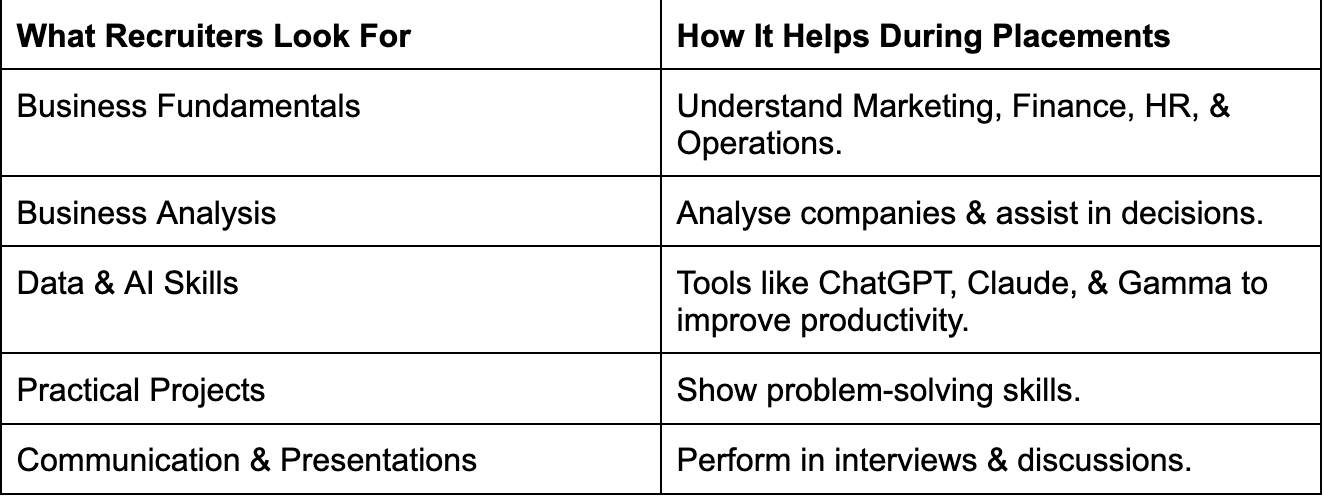
Students who graduate with such skills are often better prepared for placement opportunities.
Why Practical Experience Makes The Difference?
Business knowledge is important, but employers also want students who can apply what they have learned. However, theory alone doesn’t give students hands-on experience. Which is why practical experience has become one of the biggest factors for placements.
Students who work on live projects and complete internships often have stronger examples to discuss during interviews. Experiences such as analysing a listed company’s financial statements, building a marketing strategy, creating business dashboards, or presenting solutions to real business problems help students demonstrate both their knowledge and their ability to apply it.
These experiences build confidence and help students develop problem-solving, communication, analytical thinking, and decision-making skills, making them better prepared for placements across consulting, marketing, finance, business analytics, and other business functions.
Why AI Skills Give BBA Graduates An Advantage
Business functions are changing as AI is a part of everyday work. Today, professionals in marketing, finance, human resources, and operations use AI for research, analysis, generating reports, discussing ideas, and decision-making. As a result, employers value graduates who know how to use these tools effectively alongside their business knowledge.
A modern BBA program should therefore help students become familiar with AI as a business tool rather than a replacement for business fundamentals. Learning skills such as dashboard creation, business research, and using AI tools can help students work more efficiently and solve business problems with greater confidence.
Some AI and business skills that are becoming increasingly valuable include:
- Business research and market sizing
- Financial statement analysis
- Customer segmentation and competitive analysis
- Digital marketing and campaign analysis
- Business strategy and data-driven decision-making
When combined with business fundamentals and hands-on experience, these skills help graduates stand out during placements and prepare them for the way businesses operate today.
Choosing a BBA Degree That Leads To Better Placements
Getting better placements doesn’t depend on preparing only during the final semester. It depends on choosing a BBA degree that helps students build the right skills, gain practical experience, and understand how modern businesses operate from the beginning.
This is where the curriculum becomes important. A well-designed BBA program should combine business fundamentals with live projects, internships, AI tools, and opportunities to solve real business problems. By the time students graduate, they should have a portfolio of work that shows skills rather than just a degree.
This is the approach followed at Stride School of Business, India’s first AI-native business school. Alongside core BBA subjects, students analyse listed companies, build marketing campaigns, create business dashboards, complete internships, and graduate with over 25 real business projects in their portfolio.
For aspiring entrepreneurs, Stride School of Business also provides opportunities to build real ventures during the program. Promising business ideas will receive seed funding of up to ₹1 crore, giving students the opportunity to turn their ideas into businesses while still in college.
Ultimately, the key to better placements after BBA isn’t just earning a degree. It’s graduating with the knowledge, skills, projects, and industry experience that employers are looking for in today’s business environment.
The business world will continue to evolve, and so will the expectations of employers. Students who begin preparing during their BBA will be better positioned to succeed when placement season arrives.
FAQs
1) What factors lead to better placements after BBA?
Better placements depend on business knowledge, practical experience, internships, projects, communication skills, and AI skills.
2) Do internships improve BBA placements?
Yes. Internships provide students with industry exposure and hands-on experience, allowing them to apply classroom learning in real business situations.
3) Are AI skills important for BBA placements?
Yes. As AI is a part of marketing, finance, human resources, operations, and business analytics, employers value graduates who know how to use AI tools to improve productivity.
4) What do recruiters look for during BBA placements?
Recruiters typically look for a strong understanding of business fundamentals, practical project experience, communication skills, problem-solving ability, internships, and the confidence to apply business concepts in real-world situations.
5) How do I choose a BBA program with good placement opportunities?
Look beyond placement statistics alone. Look at the curriculum, practical projects, internships, industry exposure, certifications, AI integration, faculty, and the opportunities students receive to build a strong portfolio before graduation. Stride School of Business combines core BBA subjects with AI skills, live business projects, internships, and entrepreneurial opportunities.