13 July 2026
What AI Skills Should Every Business Student Learn?
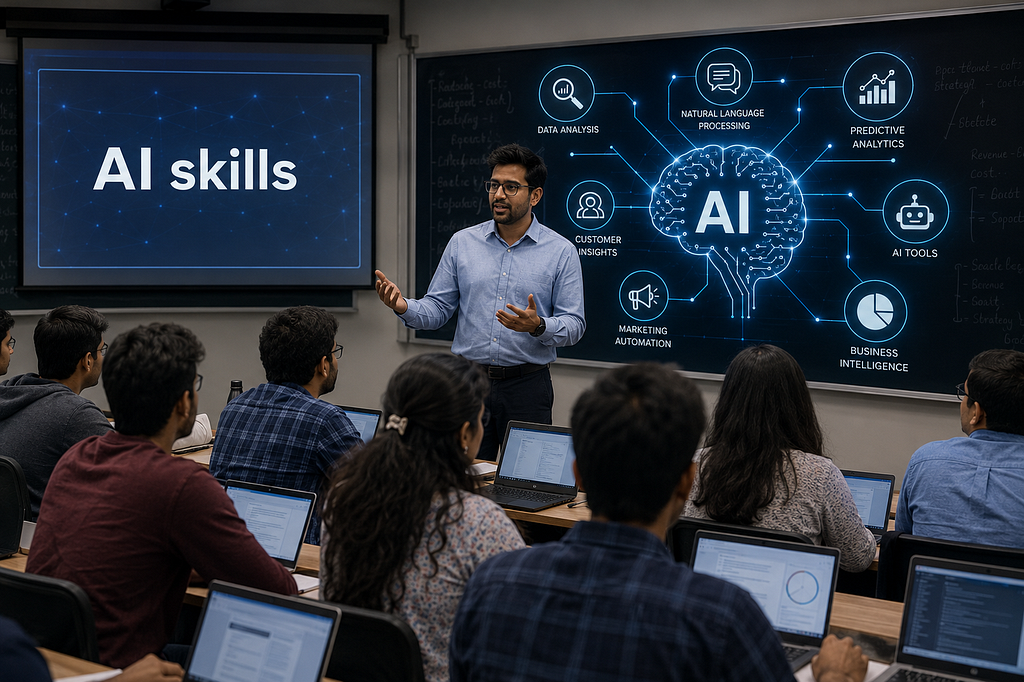
Employers are no longer looking for business graduates who only understand business theory from textbooks. They value candidates who use AI to improve productivity, analyse information, and support decision-making. As a result, the definition of a “future-ready” business graduate is changing faster than ever.
According to AACSB’s 2026 report on AI in business education, 77% of employers expect new graduates to have practical experience using AI, and 58% believe higher education institutions are not doing enough to develop these skills. This gap means that earning a business degree is no longer enough. Students are expected to understand how AI can help in businesses.
Many students focus on learning individual AI tools. While becoming familiar with these tools is valuable, employers look for graduates who know how to use multiple AI to research, analyse, interpret data, and support decision-making across different business functions.
Why Should AI Skills Matter Today for Students?
Earlier, business graduates were taught to understand concepts such as marketing, finance, operations, and human resources; these fundamentals remain essential. But, the way the core functions work has changed. Today, professionals across every business function use AI.
This doesn’t mean AI replaces business knowledge. Instead, AI allows professionals to work faster, explore more possibilities, and make better-informed decisions. Employers therefore prioritize graduates who understand business fundamentals and know how to apply AI to solve practical business problems.
The most valuable AI skills are not about mastering a single tool. They are about using AI to improve research, analysis, decision-making, communication, and execution. These are the skills that will help business students stand out during internships, placements, and throughout their careers.
1. AI-Powered Marketing & Customer Growth
Marketing today is driven by data, customer insights, and AI as much as creativity.They use AI to understand customer behaviour, analyse competitors, create content, optimise campaigns, and make faster marketing decisions. As a result, business students who know how to combine marketing fundamentals with AI will be better prepared for modern business roles.
Today, AI can help design visuals, identify target audiences, monitor competitors, and analyse campaign performance in minutes. But using these tools effectively still requires a strong understanding of marketing principles. Students need to know what they are trying to achieve before AI can help them achieve it.
This is why one of the most valuable skills a business student can develop is the ability to use AI to solve marketing problems. These skills are becoming important across startups, agencies, consulting firms, and large organisations.
A future-ready BBA program should therefore give students opportunities to apply AI to real marketing challenges rather than limiting learning to classroom theory. Building marketing strategies, creating content, understanding audiences, and using AI to improve business growth are practical experiences that help students graduate with skills employers can immediately recognise.
2. Business Research & Company Analysis
One of the biggest advantages AI offers businesses today is the ability to analyse large amounts of information quickly. However, AI alone cannot determine whether a company is performing well or whether a business opportunity is worth pursuing. These decisions still depend on human judgement backed by strong business knowledge.
Business students should learn how to use AI to research companies, interpret financial information, evaluate markets, and identify growth opportunities. Skills such as analysing financial statements, understanding unit economics, estimating market size, comparing competitors, and diagnosing business performance are becoming valuable across several roles.
AI can significantly reduce the time required to gather and organise information, allowing students to focus on what matters most, interpreting the findings and making informed business recommendations. Rather than spending hours collecting data, they can devote more time to understanding why a company is growing, where its challenges lie, and what strategies could improve its performance.
A future-ready BBA program should therefore give students opportunities to analyse real businesses instead of relying only on textbook case studies. Working on projects that involve researching listed companies, evaluating financial performance, and developing AI-assisted business reports helps students build practical analytical skills that are directly relevant to today’s workplace.
3. Building Entrepreneurial Skills with AI
Starting a business has traditionally required significant time, resources, and experience. Today, AI is making many parts of that journey more accessible. Entrepreneurs can use AI to validate ideas, build marketing campaigns, create online storefronts, analyse financial performance, automate routine operations, and make faster business decisions. This allows students to spend less time on repetitive tasks and more time solving real business problems.
However, AI alone cannot build a successful business. Students still need to understand pricing, financial planning, operations, negotiation, customer needs, and business strategy. AI works best when combined with strong entrepreneurial thinking, helping founders execute ideas more efficiently rather than replacing the decisions that drive a business forward.
A future-ready BBA program should therefore go beyond teaching entrepreneurship as a theory. Students should have opportunities to launch real ventures, work with customers, manage finances, and use AI to support marketing, operations, and decision-making. Experiencing how a business operates in the real world builds confidence, develops problem-solving skills, and prepares students for careers in startups, family businesses, or their own entrepreneurial ventures.
Not every Business Program Can Teach These Skills
Students need opportunities to apply AI in real business situations while simultaneously building a strong understanding of business fundamentals.
This is why choosing the right BBA program is becoming more important than ever. AI should be integrated throughout the curriculum, allowing students to apply it in business from the beginning.
This is the approach followed at Stride School of Business, India’s first AI-native business school.
From the first semester, students analyse the financial performance, market size, and unit economics of real listed companies while learning how to use AI for business research and analysis. As students progress through the program, they create AI-powered marketing campaigns, build content channels, develop analytics dashboards, map competitors, and design AI-assisted growth strategies for businesses.
The curriculum gradually moves beyond execution. Students build AI-powered business systems, work with AI agents, complete internships with industry partners, launch real businesses, where they generate actual customers and revenue while studying.
Students with promising business ideas can access seed funding of up to ₹1 crore, giving aspiring founders an opportunity to turn innovative ideas into real ventures during their BBA.
By graduation, students will have completed 25+ practical business projects, earned industry-recognised certificates, and developed practical experience in areas.
FAQs
1) Do business students need to learn coding to use AI?
No. While basic technical knowledge can be useful, business students are not expected to become software developers. The focus should be on understanding how to use AI to solve business problems, analyse data, improve marketing, and support decision-making.
2) Which AI skills are most useful for business students?
Some of the most valuable AI skills include AI-powered marketing, business research, financial and company analysis, customer segmentation, market sizing, business analytics, and entrepreneurial problem-solving. These skills help students apply business concepts more effectively in real-world situations.
3) Will AI skills improve placement opportunities after a BBA?
Yes. As businesses use AI across marketing, finance, human resources, consulting, and operations, employers value graduates who can combine strong business fundamentals with practical AI skills. Hands-on experience with real projects and AI tools can make students more competitive during placements.
4) How can I learn AI skills alongside a BBA?
The best way is to choose a BBA program that integrates AI into the curriculum rather than teaching it as a separate subject. Students should look for opportunities to work on live business projects, analyse real companies, complete internships, build practical portfolios, and earn industry-recognised certifications while learning core business concepts.