25 July 2026
What Skills Should a BBA with AI Build Across Every Business Function?

Every successful business depends on multiple functions working together to make decisions and drive growth. As AI becomes a part of all the functions of a business, the skills required across every function are changing. Reflecting this shift, AACSB’s 2025 global survey on generative AI in business education found that 65% of business schools worldwide already integrate or plan to integrate AI into their curriculum.
This means that a BBA with AI should help students understand how every business function works while developing the practical skills needed to solve real business problems using AI. A BBA with AI should equip students with a broad foundation that can be applied across each functional department of a business.
So, what skills should a BBA with AI build across every business function?
Marketing: Understanding Customers and Markets
Modern marketing is no longer just about creating advertisements or social media content. Businesses rely on marketers who can understand customer behaviour, identify market opportunities, analyse competitors, and measure the performance of every campaign. Companies like Zomato continuously analyse customer preferences, campaign performance, and market trends to personalise offers and improve customer engagement A BBA with AI should therefore help students build practical skills in market sizing, customer segmentation, competitive analysis, digital marketing, growth strategy, and business storytelling. Students should also learn how to use AI to research markets, create marketing content, analyse campaign performance, and make data-driven decisions that help businesses attract and retain consumers.
Finance: Turning Numbers into Business Decisions
Finance is about much more than understanding balance sheets or calculating profits. Every business decision, whether it’s launching a product or planning future growth, depends on strong financial analysis. A BBA with AI should help students develop practical skills in reading financial statements, analysing unit economics, evaluating costs, building financial models, and understanding pricing strategies. By combining these business fundamentals with AI-assisted analysis and scenario planning, students can learn how to interpret data, evaluate opportunities, and make informed financial decisions that support long-term business growth.
Human Resources: Building High-Performing Teams
People are at the heart of every successful business, making human resources crucial as it handles that exact factor. Modern HR professionals today are expected to identify talent, support employee development, improve collaboration, and make informed decisions using data and AI. A BBA with AI should therefore help students develop skills in employee management, communication, negotiation, leadership, and decision-making. As AI becomes part of hiring and workforce planning, students should also learn how technology can support HR processes while ensuring that human judgement, empathy, and collaboration remain central to building successful teams.
Operations: Making Businesses More Efficient
Operations is the backbone of every business, ensuring that products and services are delivered efficiently while maintaining quality and controlling costs. Today’s operations professionals use data, automation, and AI to streamline workflows, improve productivity, and solve operational challenges. A BBA with AI should help students develop practical skills in business operations, process optimization, business analytics, AI-powered automation, and workflow management. By understanding how technology and AI agents support day-to-day operations, students learn how businesses can improve efficiency.
Business Strategy & Entrepreneurship: From Ideas to Execution
Every successful business begins with a strategy. Whether launching a startup or leading an established company, professionals need to identify opportunities, solve problems, and make informed decisions that drive growth. A BBA with AI will help students develop practical skills in business strategy, market analysis, consulting, product thinking, pricing strategy, and entrepreneurship. By learning how to evaluate markets and business challenges, validate ideas, and use AI to support strategic decision-making, students build the confidence to lead projects, solve real business problems, and transform ideas into sustainable businesses.
How Does Stride School of Business Build These Skills?
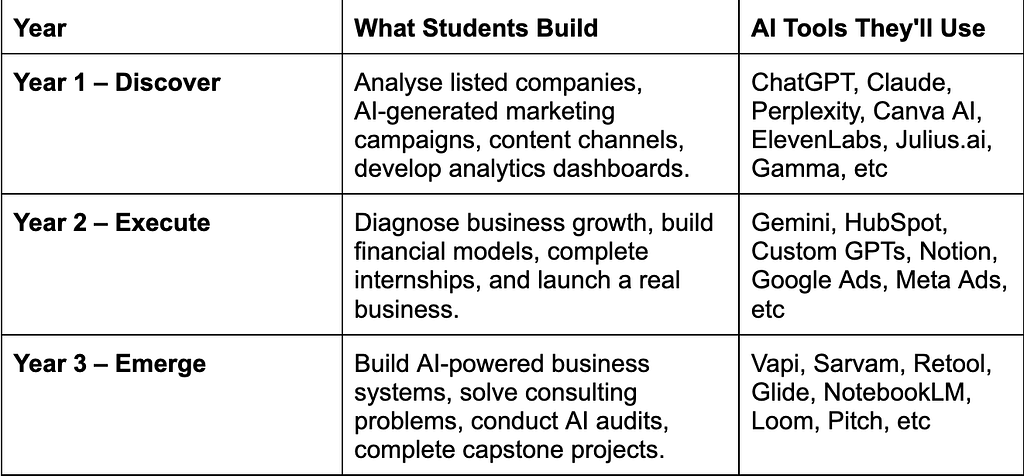
Knowing what skills businesses value is only one part of the equation. The real difference lies in how students develop those skills. Rather than treating marketing, finance, strategy, and AI as separate subjects, Stride School of Business integrates them through continuous application over three years with live projects and real business challenges. Throughout the program, students work with 15+ industry-leading AI tools, applying them across marketing, finance, operations, strategy, and entrepreneurship instead of learning AI as a standalone subject.
From the very first semester, students analyse listed companies, break down financial statements, study market opportunities, and use AI to solve business problems. As they progress through the program, they move beyond simulations to building content channels, creating analytics dashboards, completing internships, and even launching real businesses. By graduation, students have worked on 25+ real projects, developed a portfolio of practical work, and gained experience applying business concepts across every major function.
Why This Approach Prepares Students for More Than One Career
Marketing teams work closely with finance, operations rely on data from multiple departments, and business leaders make decisions with insights from every function. This is why employers value graduates who understand how different areas of a business work together rather than specialising too early.
A BBA with AI should prepare students with a broad business foundation that can be applied across multiple career paths. Whether graduates choose marketing, finance, business analytics, consulting, operations, entrepreneurship, or pursue higher studies, the combination of business fundamentals, practical experience, and AI skills helps them adapt to changing business environments and build long-term careers rather than preparing for a single job role.
FAQs
1) What skills should a BBA with AI help students develop?
A modern BBA with AI should build skills in the core business functions and in AI tools to that can be integrated.
2) Why should business students learn multiple business functions?
Understanding how different functions work together helps students solve business problems and prepare for diverse career opportunities.
3) How is a modern BBA with AI different from a traditional BBA?
It combines business fundamentals with AI, live projects, internships, and real-world applications instead of focusing only on classroom learning.
4) How does Stride School of Business prepare students across every business function?
Stride School of Business combines business fundamentals with AI, 25+ real projects, internships, industry certifications, and practical learning across every major business function.